
02/11/2012 Frey Winery Hosts California Nuclear Initiative Event

Saturday, February, 11th at 6:00 PM

Location: Frey Winery in Mendocino’s beautiful Redwood Valley

14000 Tomki Rd, Redwood Valley, CA 95470
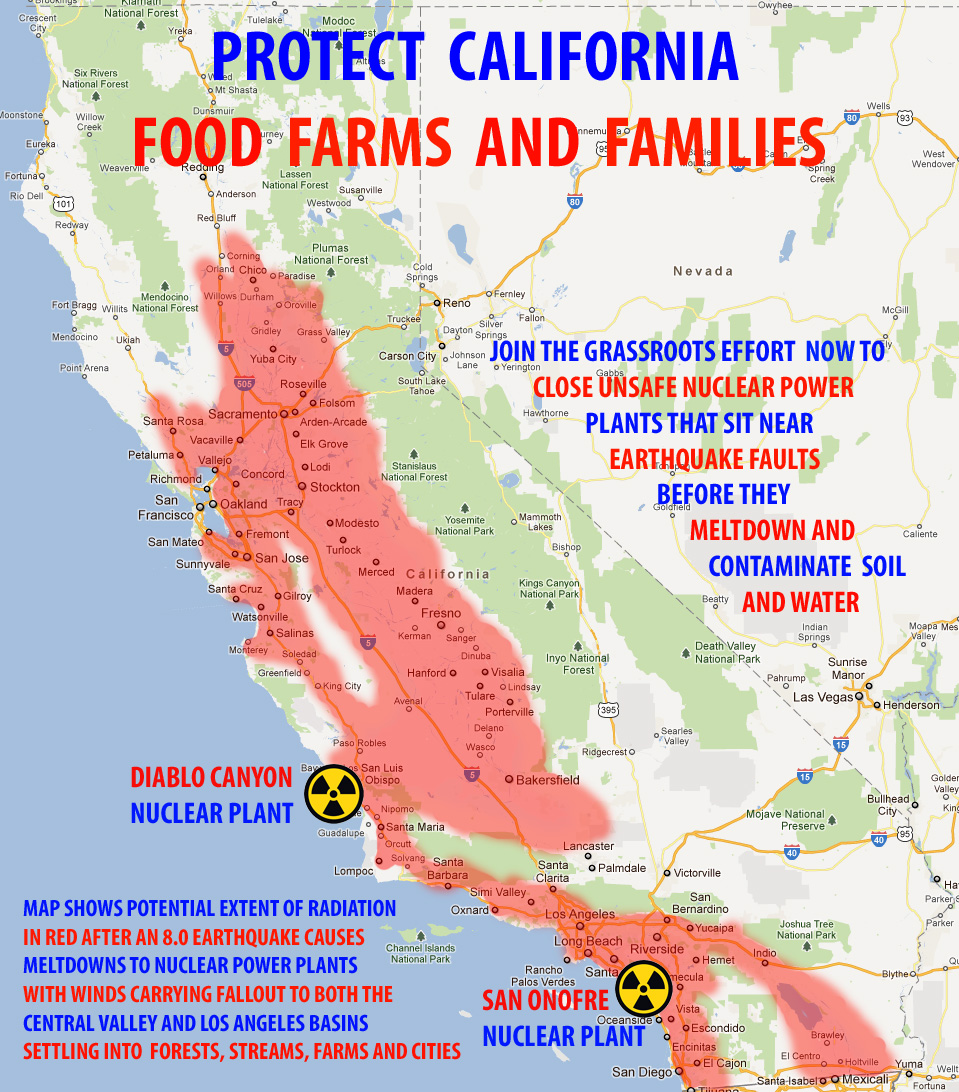
California Radiation Map after Meltdown - Paul Frey

Potential extent of radiation after meltdown

To protect organic food, wine, farms and families from nuclear power plants located near active earthquake faults, America’s first organic winery has assembled an evening of speakers and discussion around nuclear energy in California and the California Nuclear 2012 Ballot Initiative to close the State’s two nuclear power plants which sit near major active earthquake faults.

Organic Pizza (made with ingredients grown at Frey Winery) baked in the winery’s beehive outdoor oven will be served along with Frey organic wine.

Speakers to be announced, presentations will be given, petitions and information will be available to sign and take. Local music provided.

To learn more about the event and Frey Winery visit www.freywine.com.

Paul Frey, Frey Winery
707- 485 -5177
paulfrey@freywine.com
 
Mark House, Organic Farmer
707-513-5843
mahouse729@gmail.com
 

A nuclear meltdown in California would potentially result in the winds carrying the fallout to both the Central Valley and Los Angeles basins, settling into forests, streams, farms and cities.

Diablo Canyon and San Onofre Nuclear Power Plants operate near some of the largest population centers and most important agricultural lands in the US. The March 2011 triple meltdown and large radiation releases at Fukushima Daiichi Nuclear Power Plant in Japan have brought the risks and cost of nuclear power to the forefront of public debate.

California’s two Nuclear Power Plants, both built in the 1970’s, are approaching the end of their 40 year design life, and have been plagued with problems for many years, both sit on active Earthquake faults. San Onofre has the worst safety record of the nation’s 64 nuclear power plants, as the recent January, 31st accident and radiation release attest.

It is time for California, the nation and the world to begin a rational and fact based discussion about the costs and dangers of operating old, poorly designed and poorly sited nuclear plants.

California has excess energy without these two nuclear power plants. In addition, renewable energy alternatives exist and conservation measures can be enacted to add to our energy supply. The Japanese have made this clear, after shutting down 50 of its 54 nuclear power plants in response to the Fukushima Disaster.

Frey Winery location

 
Posted in Calif Nuclear Initiative, Events, How to Help | 2 Comments

San Onofre and Other Nuclear Plants’ Mechanical Failures

Kevin Kamps, Beyond Nuclear joins Thom Hartmann.

California’s San Onofre nuclear power plant was unexpectedly shut down after radioactive water was discovered leaking out of the plant’s Unit 3 reactor [resulting in the release of radioactive vapor into the air]. And inspection of the Unit 2 reactor showed unusual accelerated wear in a large percent of the steam generator tubes.

Kevin Kamps said with a cascade of two ruptures in the steam generator, you could have a loss of coolant accident in the core which could lead to a meltdown, which could lead to a China Syndrome, burn through containment, and a catastrophic radioactivity release.

Key replacement parts, including steam generators, have been a problem at other nuclear power plants in the country — yet the Nuclear Regulator Commission approves plants going back on-line with defects.  But wait – there’s more…

Posted in NRC, Radiation Monitoring, Safety Allegations, Steam Generator, Video | Tagged , , , , , | 2 Comments

Whistleblower Interview: San Onofre – How Safe Is It?

NUCLEAR HOTSEAT SPECIAL REPORT

Libbe HaLevy interviews whistleblower James Chambers

A summary of the current status of San Onofre nuclear reactors after last week’s leaks, discovery of over 800 damaged pipes, and employee falling into the radioactive refueling pool. Featuring an interview with James Chambers, a licensed nuclear reactor operator and whistleblower from San Onofre, who offers his unique perspective on what these alarming developments might mean.

Posted in Nuclear HotSeat, Radiation Monitoring, Safety Allegations, Steam Generator | Tagged , , , , | 22 Comments

Inspectors find ‘unusual’ wear on San Onofre steam generator tubes

Unusual wear has been found on hundreds of tubes that carry radioactive water at Southern California’s San Onofre Unit 2 nuclear plant, raising questions about the integrity of equipment the company installed in a multimillion-dollar makeover in 2009.

San Onofre Power Plant prohibited from restarting – Los Angeles Times 03/28/2012 
 

These steam generators had manufacturing problems from the beginning and San Onofre was allows to deviate from normal standards.  See Welding defects in Unit 3 Reactor.

Posted in NRC, Radiation Monitoring, Steam Generator | Tagged , , , , | 1 Comment

Edison says they have ample reserve power without San Onofre

Although both of San Onofre’s reactor units are now offline, with no word on how soon unit 3 can be restarted, [Edison spokesperson Gil] Alexander said Edison has “ample reserve power” to supply customers.

             San Onofre: 100s of troubled tubes, gas leak – OC Register 02-02-2012
 

If we have “ample reserve power”, why are we taking the risk of a nuclear meltdown and radiation of our food, water and air? Why are we risking bankrupting our citizens and California?

The Nuclear Regulatory Commission (NRC) says San Onofre has the worst safety record of all nuclear power plants in the USA (based on safety allegation reports) and Edison retaliates against employees who report safety problems.

The NRC and other government entities appear “powerless” to effectively safeguard us from these and other problems at San Onofre. How did one year old steam generators that appear to be defective, get approved for installation? Why does the NRC allow a nuclear plant that would not be approved by current NRC standards for new nuclear plants continue to operate? The NRC’s own data shows they lower standards in order to keep old nuclear plants like San Onofre running. They are putting profits over our safety and our financial future.

The citizens of California have an opportunity to effectively shut down both remaining nuclear plants in California. Please download and sign the California Nuclear Initiative petition so we can get it on the ballot for the November 2012 election. We need over 500,000 signatures by April.

Please share this information with others. Don’t risk California becoming Fukushima USA.

For more information on why we don’t need San Onofre’s power, see Energy Options.

Posted in Calif Nuclear Initiative, Energy Options, How to Help, NRC, Safety Allegations, Steam Generator | Tagged , , , , , | 1 Comment

Radiation Levels Hidden from Public

There is a very serious problem at the San Onofre Nuclear Generating Station, but all we hear from Southern California Edison (SCE) and the Nuclear Regulatory Commission (NRC) is the same old story they always say: “everything is safe, very little if any radioactivity was released, “you will be fine”. But the fact is the only people actively monitoring the release of radioactivity is SCE and they will not release the information to the public. So we the citizens of San Clemente have no idea how much radiation was released and for how long. All of these things affect the quality of life for those of us in our beautiful seaside community, including our health and property values.

What we the citizens of San Clemente want to know is, where is the monitoring system in real time so we know what was released and for how long? SCE knows but will not release the information.

At Residents Organized for a Safe Environment (ROSE), San Onofre Safety (SOS) and Nuclear Free California (NFC), we ask “where is the monitoring system that the citizens deserve after living next to San Onofre periodically releasing highly radioactive materials on an ongoing basis all of these years?

Why hasn’t the city of San Clemente, Orange County government,  the state of California and the federal Environmental Protection Agency seen fit to actively monitor the ongoing release of radioactivity from this plant and to share the information timely with the public? Why isn’t there an epidemiology study to find out what the effect of these many releases over the years has done to our community? Are the city, county, state and federal government officials not aware of the recent study around France’s nuclear power plants? This study found an alarmingly high rate of childhood leukemia within a 25 mile radius of their nuclear power plants.

Finally it is time for a change. It is time for the STATES to QUESTION the AUTHORITY of the NRC and its supremacy of all things nuclear. It is not 1950 any longer. The states and the citizens themselves are now much better informed about the effects of living with radiation. Ask the people near Chernobyl in Russia and the people near Fukushima in Japan.

Residents Organized for a Safe Environment

Posted in City Council, NRC, Radiation Monitoring | 2 Comments

Welding Defects in Unit 3 Steam Generator

San Onofre’s Unit 3 reactor steam generator (currently leaking) had problems from the start.  According to this Nuclear Regulatory Commission Information Notice 2010-07: Welding Defects in Replacement Steam Generators:

The welding defects identified at the fabrication facility on the replacement steam generators (RSGs) for SONGS Unit 3 are unlike the weldability issues that are typically observed in the welding of nickel-based alloys. For the SONGS Unit 3 RSGs, surface preparation for the Alloy 152 butter was inadequate. Contamination from the air carbon-arc gouging (ACAG), used to remove the stainless steel cladding, resulted in elevated hardness of the material adjacent to the fusion line that remained on the surface after the grinding step. When the butter pass was applied, the metallurgical bond between the LAS and Alloy 152 butter weld pass was not as strong as it should have been.

The fabricator followed approved welding procedures for dissimilar metal welding of Alloy 690 to low-alloy steel (LAS) and had recently built two RSGs for SONGS Unit 2 according to these procedures without problems. However, for the SONGS Unit 3 RSGs, the fabricator requested and the licensee approved a deviation to allow using an alternative method (in this case ACAG) to prepare the LAS surface for butter application. According to the American Society of Mechanical Engineers Boiler and Pressure Vessel Code (ASME Code), Section IX, this deviation did not require the requalification of the welding procedure because this aspect of the weld joint preparation was not considered an essential variable.

ACAG could be used in the manufacturing or repair of any ASME Code Class 1, 2, or 3
component. The ACAG technique is an accepted procedure for removing metal. American Welding Society (AWS) C5.3:2000, “Recommended Practices for Air Carbon Arc Gouging and Cutting,” states that welding on a surface after ACAG “may generally be performed with a minimum of grinding or cleaning.” However, the standard also notes the limitation that the process “increases the surface hardness on cast iron and air hardenable metals. This may be objectionable.”

ACAG is not specifically covered in Section III of the ASME Code; however, ASME Code, Section XI, IWA-4461 covers the qualification and use of a thermal removal process like ACAG. In addition, 10 CFR 50.55a(b)(2)(xxiii) states:

The use of provisions to eliminate the mechanical processing of thermally cut surfaces in IWA-4461.4.2 of Section XI, 2001 Edition through the latest edition and addenda incorporated by reference in paragraph (b)(2) of 10 CFR 50.55a are prohibited.

Although all specific requirements or standards were met, this event illustrates that control over all aspects of welding ASME Code Class 1, 2, and 3 components can prevent welding defects like those found in the RSGs for SONGS Unit 3 from occurring.

Posted in Steam Generator | 2 Comments

San Onofre Radiation Leak 2/1/2012

Southern California Edison finally admits to possible radiation leak at San Onofre – SF Gate 2/1/2012

A tiny amount of radiation may have escaped from the San Onofre nuclear power plant after a water leak prompted operators to shut down a reactor as a precaution. The leak was detected Tuesday afternoon in reactor Unit 3.

Also concerning was that “many” tubes that carry pressurized radioactive water were damaged, according to a spokesman for the Nuclear Regulatory Commission.

The tubes are part of equipment that is virtually new, having been installed in 2010.

“The damage that they have found to many other tubes is unusual, and they are attempting to identify the reason,” NRC spokesman Victor Dricks said.

News of the possible leak was slow to emerge. Shortly after the incident, Southern California Edison (SCE) issued a statement saying, “There has been no release to the atmosphere.”

On Wednesday morning, however, Dricks said a small amount of radioactive gas “could have” escaped from a building that houses auxiliary equipment.

The Unit 3 reactor returned to full power in February 2011 after its two aging steam generators were replaced. The plant’s other reactor, Unit 2, had similar work. The retrofit cost more than $670 million.

Daniel Hirsch, who lectures on nuclear policy at the University of California, Santa Cruz, said he was concerned that the problem occurred with recently installed equipment.

 “Edison has historically not been candid about the problems at San Onofre. That lack of transparency causes tremendous distrust and increases risk,” Hirsch said.

“It makes one wonder about the quality assurance for the replacement equipment,” he added. “This is not due to old equipment breaking but new equipment that wasn’t up to snuff in the first place.”

The latest leak occurred in one of thousands of tubes carrying radioactive water from the plant’s reactor. The leak was initially estimated at a rate of 85 gallons a day — an amount about half of what would require the plant to shut down.

Dricks said radioactive gas that leaked from that tube in the plant’s steam generator was vented into the auxiliary building. The radiation was detected by monitors in that building, which is separate from the sealed structure that houses the reactor. Because the auxiliary building is not sealed — people come and go through doors — it’s possible radiation escaped into the atmosphere.

Each steam generator can contain as many as 16,000 tubes, each about 0.75 inch in diameter. The hot, pressurized water flowing through the tubes heats non-radioactive water outside the tubes. The resulting steam is used to turn turbines to make electricity.

According to the NRC, the tubes have an important safety role because they represent one of the primary barriers between the radioactive and non-radioactive sides of the plant. If a tube breaks, there is the potential that radioactivity from the system that pumps water through the reactor could escape into the atmosphere.

Gil Alexander, spokesman for SCE, said he could not confirm any additional damage to other tubes, pending an inspection of the equipment.

more…

Posted in Emergency Planning, NRC, Radiation Monitoring, Steam Generator | Tagged , , , , | 2 Comments

Protected: Support the California Nuclear Initiative

This content is password-protected. To view it, please enter the password below.

Posted in Calif Nuclear Initiative | Enter your password to view comments.

ACTION ALERT: email City Council at CityManager@San-Clemente.org

Dear San Clemente City Council,

Yesterday’s emergency shutdown at SONGS is yet another release of harmful radiation to our children and community. But we don’t know exactly what was released, how long, or how it will affect our citizens. It is high time that an epidemiology study is done to assess what’s going on in our community because of the San Onofre Nuclear Waste Generating Station’s on going release of radiation. Also, it is long overdue that the city & county take responsibility for a radiation monitoring system so that our citizens will know exactly what is being released and how long and at what levels. We know SONGS has a system, but they do not share this important information with our town, why is that permitted? We are the one’s who need to know. WE DEMAND ACTION NOW BEFORE IT IS TO LATE!

Posted in Action Alert, City Council, Emergency Planning, How to Help, Radiation Monitoring | Leave a comment